
| ABOUT Automotive Research Reports | |
|
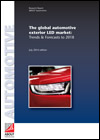
The global automotive exterior LED market
|


|
LEDs: lighting technology of the future Their small size, powerful light emission, extreme reliability, low energy requirement and long lifespan support the widely held view that LEDs are 'the technology of the future for automotive lighting.' In fact, some manufacturers go so far as to predict that the incandescent bulb is headed for extinction. Given that LEDs represent a new light source for front automotive lighting, they also require regulations to control their application. While LED headlamps are already allowed in the US, their application is limited in Europe. By 2008, however, new ECE regulations will be enforced, radically changing the appearance and performance of vehicle headlamps (and therefore the complete appearance of cars) for good. Although manufacturers expect early LED headlamp applications will cost more than HID, the two technologies could be price-comparable by 2011. That could trigger a price war, forcing a downward trend on unit prices. But by how much remains to be seen. Some manufacturers also think it is very possible that HID will disappear altogether in favour of LEDs. |
|
||||||||||||||||||||||||||||||||
|
|
|||||||||||||||||||||||||||||||||
|
Comprehensive
study addressing the key issues
This exclusive report addresses a number of topical issues facing the automotive LED market, including:
If you are looking for detailed market analysis of the global automotive exterior LED lighting market, addressing the key issues facing the industry, this report provides it. Global, data-rich report coverage: Chapter two sets out our detailed market fitment, volume and value forecasts for all exterior LED lighting applications through 2012 for:
Although we see a strong European automotive LED interior market, our forecasts are based solely on exterior automotive LED applications. Furthermore, our forecast fitment trends for LEDs are not extrapolative - based simply on trends - but dependent on the underlying drivers of supply and demand. Our estimates are supported by interviews with experts at LED manufacturers and OEMs across Europe, North America and Japan. Chapter three reviews the technical advances in vehicle LED lighting. The most promising advance is LED headlamps, expected to appear in 2008. Industry observers say LEDs will rank between halogen and xenon discharge lamps in terms of their efficiency. In addition, LED headlamps can be up to 55% thinner than their halogen/xenon counterparts, thus opening up space in the engine compartment or grille to add further styling options. Chapter four provides concise profiles on a selection of the main players in the LED market, namely:
|
|||||||||||||||||||||||||||||||||




| Automotive | ||
| Aerospace | ||
| Food | ||
| Style | ||
| Partners | ||
| Custom Research | ||
| Customers | ||
| Sample Downloads | ||
| Contact | ||